MDOT’s Simmons speaks with supervisors about projects
The impact of closing a one-lane bridge on Griffis Fountain Road in Chunky didn’t make much news in 2016 when it closed to traffic, but the impact has been felt by Chunky residents ever since.
Beat 5 Supervisor Jacky Johnson reminded Mississippi Department of Transportation Central District Commissioner Willie Simmons of the importance of the bridge when Simmons met with the board during their last regular meeting. Johnson had some pointed questions for Simmons about why the bridge had not made the list of repair projects that Simmons brought to the board.
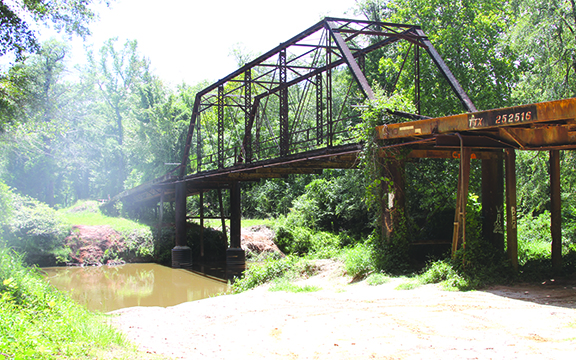 The one-lane bridge on Griffis Fountain Road in Chunky has been closed since 2016, which has caused trouble for nearby residents.
Photo by Amy Robertson / The Appeal
As part of the state and federal programs designed to repair and replace bridges and roads beginning in 2013, the “Rattlin Bridge,” as it is known by most residents, was placed on the closure list in late 2015 and eventually closed in 2016. Johnson knew at the time that closing the bridge might not seem impactful on paper, but in the reality of the families living between the railroad track and around the Chunky River, the closing was significant. The “Rattlin Bridge” offers residents on the south side of the tracks an outlet when long lines of rail cars come through Chunky and both crossings are blocked. For residents on the south side of “Rattlin Bridge” the bridge offered quicker access to Chunky and the interstate.
While Simmons told the board that the legislature had provided 1.4 billion dollars in funding for road work - the most ever received in any year - Beat 5 Supervisor Jacky Johnson noted that the bridge that serves about 40 families from his district did not make the repair/replacement list.
Simmons explained that a repair/replacement list program was set up in 2018. The program, commissioned by the MDOT through an outside agency, would take data submitted to the formula and create a list that set a list of priorities for repair/replacement work. According to the formula, the Griffis Fountain Road bridge has never been re-opened due to the bridge not making the state’s list, and Johnson took issue with the priority list.
“Tell that to those 40 families that live between that railroad and that bridge that if something happens and there’s no way out,” Johnson said. “There’s nothing in that formula that can be tweaked a little bit?”
Chunky resident Jennifer Clark understands exactly what Johnson is talking about because her residence sits squarely between the bridge and the railroad track. Clark noted the inconvenience of sitting at the track when both crossings are blocked, in one instance for more than two hours, to the fear of the yet unrealized medical emergencies.
“When my husband was working at the coal plant he had to go in late because the train was blocked both was and there was no way out,” Clark said. She noted that this time of inconvenience had happened several times to her and other family members, but she was more concerned about life and death situations.
“Say, for instance, a train was to derail or something was to happen, there’s no way out of here. We’re blocked in. I think about a lot of the elderly people that live on this side (of the bridge) and if something happened to somebody and the train was stopped on the track there’s just no way out. We sit here and wait until the train moves because there’s no way out of here.”
Johnson expressed similar concerns to Simmons.
“If I lived in one of those 40 houses of people over there that is about the worst you can get if a train derails over there,” Johnson said. “Do you know what kind of chemicals come up and down that track?” Simmons said he did not and Johnson told him that many were dangerous.
Simmons said the bridge would still continue to work its way up the prioritized list as other higher priority projects were completed.
Simmons stressed that the formula was used to take the human element out of decision making, but Johnson said that was part of the problem. “I see that you did (remove the human element). I can see your point, but I hope you see mine,” Johnson said.
“When we get into an emergency situation where bridges are about to collapse, and you can’t get emergency vehicles to and from then it takes on a different kind of meaning for us,” Simmons said. “When the bridge is in a state like that and fire engines and ambulances can’t get in and life is threatened that takes on a different meaning.” Simmons said.
Johnson said state funding would have to be a part of the project simply because of the replacement cost. The replacement of the bridge would cost and $3.2 million to replace and widen the bridge. “It’s something we’re working toward, but the price tag has got me shut down. With my budget of $500,000 per year, it would take me a long time to complete it.”
Clark said with repairs she probably would not use the bridge every day, but would feel better if it were reopened.
“I wouldn’t use it every day, but I would like to know if was there especially for the people on the other (south) side of the bridge. They have to go all the way around to get into town right now. It could be really bad trying to get help to someone.”
In his report to the board, Simmons noted several projects that have recently been completed and others that are about to begin.
Projects recently completed:
Hwy. 15 mill and overlay from Decatur to Henry Mack Smith Road - $3.4 million
Hwy 492 mill and overlay from Scott County Line to Bridges - $923,063.74
Hwy. 492 mill and overlay from Decatur Street to Hwy, 15 - $289,208.50
Ongoing projects:
US 80 bridge preservation over KCS Railroad - $1.5 million
Bridge Preservation on 1-20 Bridges 113.8 and 120.8 - $466,590.97
Upcoming projects:
US 80 Bridge 122.5 repairs on the east side of Chunky - bid let in June 2022 - cost estimate $250,000
Hwy. 15 signal in Decatur at Broad Street - in the next couple of months - $250,000.